
How to write a PA CV

To be a successful PA or EA, you will have superb organisational skills including strong diary management skills, ability to communicate efficiently at all levels, managing records, arranging all types of corporate events to mention but a few.
As the job requires strengths in these areas, your CV should embody them as much as possible. This will help to demonstrate your capabilities to a recruiter or a prospective employer. If you can create a CV that does this well enough, the chances of being called for interview are that much higher.

It is vital to get the structure and format of your CV right because it will help to demonstrate your great organisational skills and attention to detail. As a tip, aim for concise, neat and uncluttered. Choose a font that is clear – Calibri, Tahoma or Arial fonts are all ideal, as they read well in both hard and soft copy – important as your CV will probably be read on computer and printed out for the interview. Font size should be either 11 or 12. Avoid using too many colours and steer clear of any tables which can get distracting. There are a lot of websites that offer free CV templates if you prefer to use a tried and tested format.
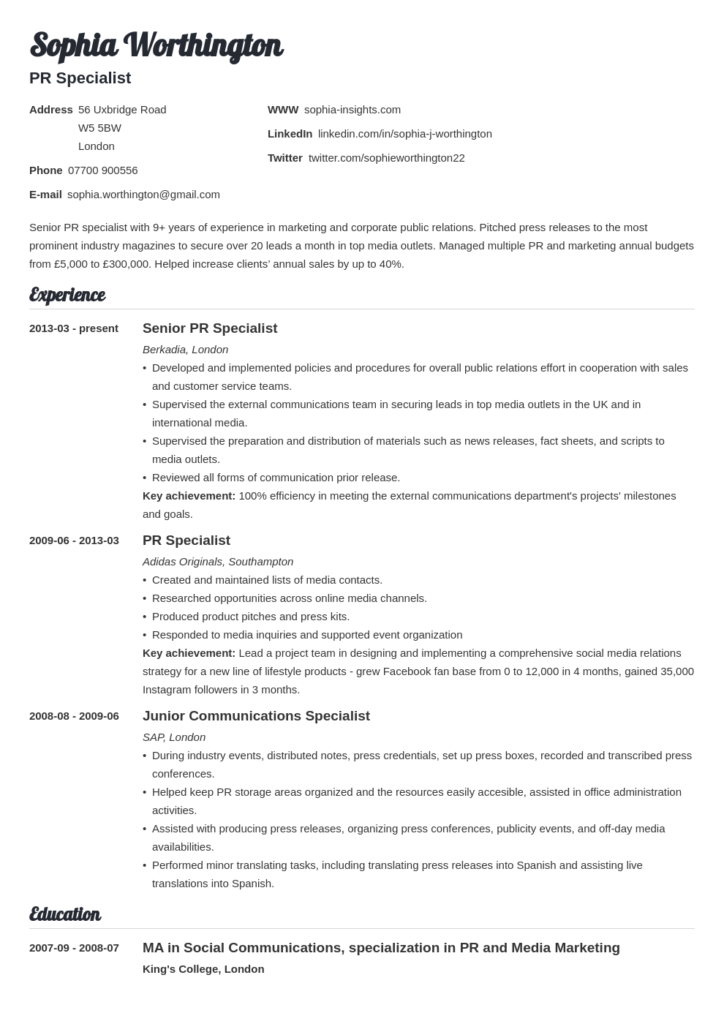
Start with your name and a short personal statement describing the skills and attributes that you have acquired during your career. If you put this at the top, you are selling yourself to your prospective employer right from the start.
Career history
Think of your CV as a list of your skills and achievements. List your most recent job first and work your way backwards. The most recent role should have the most information including how long you worked there and the skills you gained during this period. Include your dates of employment, job title and company name. Then in bullet form describe your principal activities, concentrating on those that are relevant to a PA – diary management, event organising, liaising with internal and external parties etc. Elaborate on the description of your activities so that it is more than just a list. Remember that you will be competing with tens, possibly hundreds of other candidates, many of whose experience will be very similar to yours. Therefore you must personalise your experience. You can even have a few versions of your CV which reflect the different skills you have, so that if you apply for a role which includes conference planning for example, make sure that your knowledge in that area shows through. If you know that you can do the job you are applying for, it is no bad thing to show these skills in such a way that it could put you ahead of other candidates. Always be truthful, but there is nothing wrong in “bigging” yourself up.
Education and qualifications
This should include the titles, institution and years of attendance, including professional qualifications. If you achieved good grades you can also specify these, but if not, it is best to omit. Put down where you went to school and achieved your professional qualifications. With computer skills, relate your skills to the job you are applying for. A PA or EA is expected to have good computer skills.
Interests and Activities
Remember to keep your interests professional and list your hobbies too. If you don’t really have any hobbies, then perhaps you tried something unusual when you went on holiday which could be interesting? Walking, swimming, horse riding – anything can go down and your prospective employer is not to know whether you have only done it once or whether you do it every weekend. It would be a useful talking point at the end of an interview, however little time you have spent doing it!

Finally:
Your CV should be no longer than 2 pages. Once it is complete, read it at least twice and then give it to someone whose level of English you regard highly. Ask them to identify errors and for their opinion of the clarity and structure. This will help you to ensure your CV reads well to a prospective employer. Good luck!
Related Posts

Conference Venues Near Birmingham New Street for 200 Delegates
Looking for a conference venue near Birmingham New Street Station for around 200 delegates? Birmingham city centre has several excellent options within easy walking distance of New Street, ranging from…

It’s Not Too Late to Book Your Christmas Party
September is well and truly here, the summer holidays are over and someone in the office has just asked the question nobody particularly wanted to hear: “What are we doing…

Best New Event Venues for 2027
Every year brings exciting new options for event organisers, and 2027 is shaping up to be no exception. From purpose-built conference centres to innovative meeting spaces and major regeneration projects,…

Three Iconic Historic Christmas Event Venues in London
For a Christmas celebration with a real sense of history, London offers some truly remarkable settings. IWM London, HMS Belfast and Churchill War Rooms each provide a memorable backdrop for…