
Can Technology Really Replace a Human Venue Finder? The Role of Venue-Finding Agencies in 2027
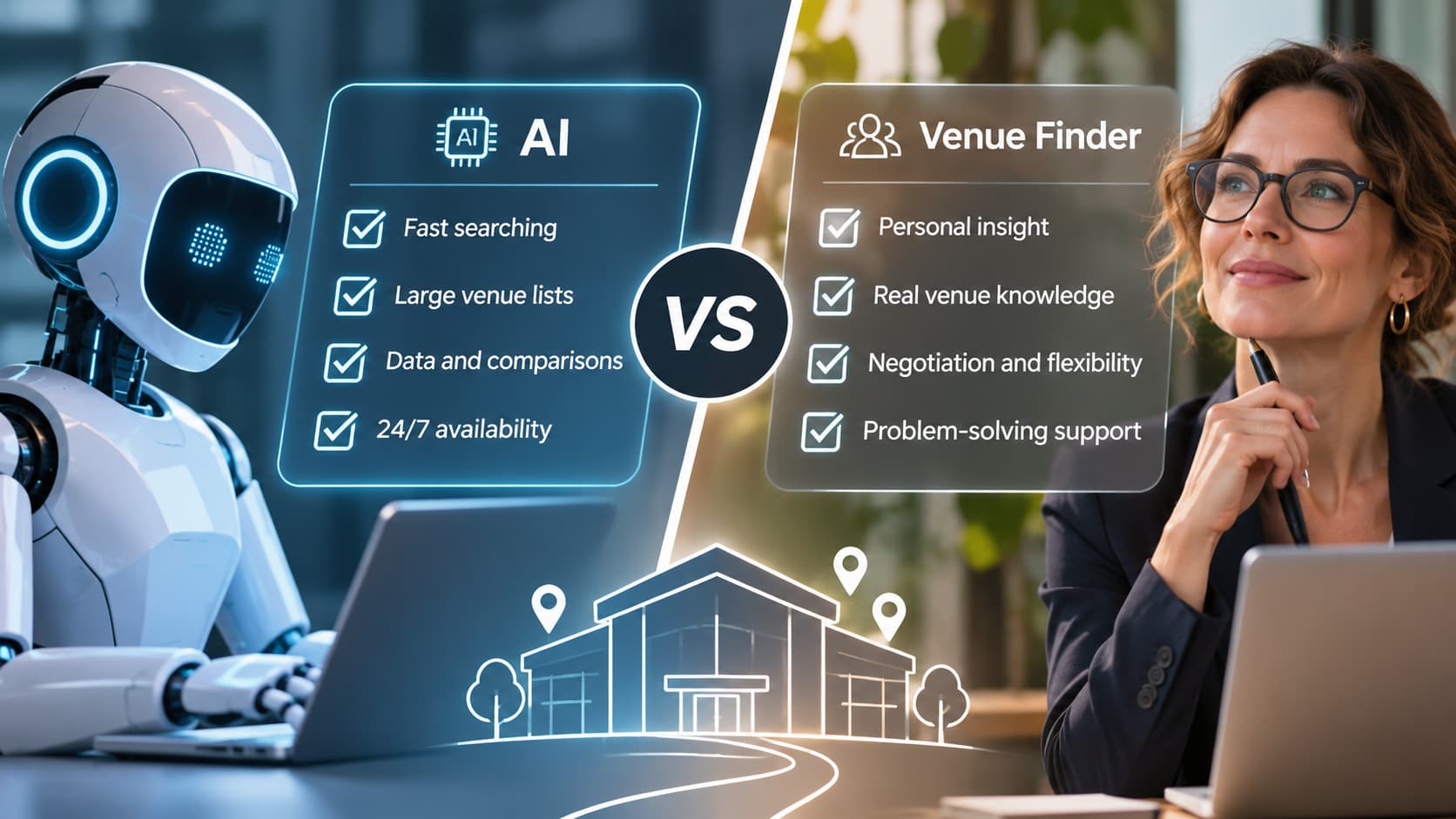
As more companies turn to artificial intelligence to automate tasks and reduce their reliance on people, could AI eventually replace professional venue finders?
Finding a venue has never been easier. Google, specialist venue platforms and AI tools can suggest hundreds of options in seconds, allowing planners to compare locations, capacities and facilities without leaving their desks.
However, finding a list of venues and knowing which one to book are two very different things. As we look ahead to 2027, we consider how AI is changing the venue-finding industry, where technology has the advantage and whether human expertise still has an important role to play.
The case for technology
There is no denying that technology has transformed venue finding for the better. A planner looking for a meeting room for 20 people in Manchester can quickly identify suitable hotels, compare facilities, check locations and, in some cases, book online without speaking to anyone.
AI tools can take this a stage further. Rather than searching through individual websites, planners can describe their requirements in everyday language and receive suggestions tailored to their event. For relatively straightforward bookings, this may be all that is needed.
Technology is particularly useful during the early research stage. It can introduce planners to venues they might not have considered, help establish realistic budgets and provide a useful overview of what is available in a particular city. It also gives planners greater independence. Someone who enjoys researching venues and has sufficient time to do so may have little reason to involve an agency.
Professional venue finders should recognise these advantages rather than pretend they do not exist.
Where technology starts to struggle
The limitations become more apparent when an event involves several competing requirements. Consider a company planning a conference for 350 delegates in London. The venue needs excellent transport connections, a main auditorium, four breakout rooms, space for an exhibition, accessible facilities, good catering and a suitable area for an evening reception.
A search engine or AI platform might identify several promising venues. What it cannot necessarily establish is whether those venues can accommodate every element of the programme on the required date, within budget, without compromising the delegate experience.
A venue may advertise a capacity of 400, but that figure might apply to a standing reception rather than a conference with a stage, production equipment and comfortable seating. An attractive exhibition space might be on a different floor from the main auditorium. A venue might have enough breakout rooms, but not enough circulation space to move several hundred delegates between sessions. These are not always details that appear in online descriptions.
Even where AI provides accurate information, it is generally working with information that has already been published or made accessible to it. Availability, negotiated rates, room configurations and operational restrictions may require direct confirmation.
This is where experience and conversations with venues become particularly valuable.
The importance of knowing a venue
One of the strongest arguments for professional venue finding is that a good agent understands more than a venue’s advertised facilities. They may have visited the property, worked with its events team or received feedback from clients who have held events there.
They know that a particular conference room has excellent natural daylight but limited blackout facilities. They may know that a venue which looks rather ordinary from the street has an exceptional events space inside. They might also know that a hotel undergoing refurbishment would be unsuitable for an important client presentation, even though the website photographs look perfect.
Of course, not every venue-finding agency has this depth of knowledge. The quality of advice depends on the experience, contacts and diligence of the people providing it. Nevertheless, firsthand knowledge and professional relationships can make a substantial difference, particularly for complex or high-value events.
Venue finding is about more than producing a shortlist
There is a tendency to judge venue-finding services by how quickly they can produce a list of options. Speed matters, especially when planners are working to tight deadlines, but a shortlist is only one part of the process. A good venue finder should be asking questions that the client may not have considered.
Is the proposed budget realistic? Will delegates be travelling from different parts of the country? Does the event need exclusive use? Are there restrictions on external caterers, branding or production suppliers? What happens if delegate numbers change? Sometimes the most useful contribution is challenging the original brief.
A client might request a hotel because that is where previous conferences have taken place, when a university, professional institution or purpose-built events venue could offer better facilities and value. Equally, a client attracted to an unusual warehouse might discover that the cost of bringing in furniture, catering, heating, lighting and technical equipment makes a traditional venue considerably more economical.
The value lies in helping the planner make an informed decision, rather than simply agreeing with the initial request.
The value of negotiation and understanding the real cost
Comparing venue prices is rarely as simple as looking at the headline room hire charge or day delegate rate. Two venues might quote similar prices but include very different services. One may provide audiovisual equipment, unlimited refreshments and dedicated event support, while another charges separately for almost everything.
An experienced venue finder can help clients understand these differences and identify costs that might otherwise be overlooked. Established relationships can also help when negotiating rates, securing additional benefits or discussing more flexible terms. That doesn’t mean that an agency will always obtain a better price. Some venues have fixed pricing policies, and clients may occasionally secure equally competitive rates by booking directly.
It is also important to understand how venue-finding agencies are paid. Many offer their services free to the client and receive commission from the venue when a booking is confirmed. This can be an attractive arrangement, but it raises a legitimate question about impartiality. A reputable agency should be transparent about its commercial relationships and recommend venues because they suit the client’s requirements, not because they offer the highest commission.
Clients are entitled to ask whether an agency works with the whole market, whether some venues are excluded and how recommendations are selected. Independence should be demonstrated through the quality of advice, rather than simply claimed.
What happens when something goes wrong?
Even the most carefully planned event can encounter unexpected difficulties. A venue might announce refurbishment work, change its catering arrangements or discover that a requested room configuration is not possible. A planner working directly with the venue will need to resolve these issues themselves.
A venue-finding agent who remains involved beyond the initial introduction may be able to help negotiate alternatives, clarify contractual arrangements or identify another suitable property. This support can be particularly valuable for busy corporate planners who are organising events alongside their normal responsibilities. However, the extent of an agency’s involvement varies. Some services concentrate almost entirely on introductions, while others support clients through site visits, negotiations and contracts.
Clients should establish what assistance is included before appointing an agency.
What does the industry evidence tell us?
Recent research suggests that technology and personal expertise are likely to coexist rather than compete for every booking.
Cvent’s 2026 Global Planner Sourcing Report, based on responses from more than 1,650 event planners worldwide, found that 75% were already using AI for venue searches. At the same time, almost a third reported that sourcing technology either hindered their workflow or provided no measurable benefit.
The report also found that 72% expected event costs to increase, while 48% were sourcing non-hotel venues to create more distinctive experiences.
These findings are significant for venue-finding agencies. Planners are becoming more comfortable using technology, but they are also dealing with financial pressures, increasingly varied venue choices and higher expectations for the events they organise. The research does not prove that human venue finders deliver better results than technology. It does, however, suggest that faster access to information has not eliminated the difficulties involved in choosing and securing the right venue.
Where do venue-finding agencies fit into the 2027 marketplace?
The traditional role of the venue finder is changing. Years ago, access to venue information was itself a valuable service. Agencies had directories, established contacts and knowledge that could be difficult for individual planners to obtain. Today, much of that basic information is freely available.
An agency whose main service is producing a list of venues from publicly available websites may struggle to justify its position, particularly as AI tools become more capable. The agencies most likely to remain relevant in 2027 are those that offer something beyond information. That could mean specialist knowledge of a particular market, access to less obvious venues, experience with complicated event requirements or the ability to manage a demanding sourcing process from initial brief to contract.
For a company organising a small meeting in a familiar location, booking directly may be the most efficient option.
For an organisation planning a national conference, an awards ceremony, a product launch or a large corporate celebration, professional advice may save considerable time and reduce the risk of choosing an unsuitable venue.
There is also room for different types of service. Online booking platforms, venue directories, independent agencies and full-service event management companies do not necessarily serve identical needs. A venue-finding agency is not the same as an event management company. Its principal responsibility is usually to source and secure the venue, although some agencies provide additional planning support. Understanding these distinctions will become increasingly important as clients decide which services they actually need.
Will AI eventually be able to do everything a venue finder does?
It would be unwise to suggest that today’s technological limitations are permanent.
AI systems are improving rapidly, and future integrations with venue booking systems could make it possible to check live availability, obtain accurate quotations, compare contracts and manage much of the communication currently handled by people. Some of the administrative work undertaken by venue-finding agencies will almost certainly become more automated.
However, this is not necessarily a threat to the best agencies. If technology can reduce the time spent searching databases, preparing enquiries and comparing basic information, experienced venue finders can concentrate on the areas where their judgement adds most value.
There is also no reason why clients should have to choose between technology and personal service. An effective venue-finding agency in 2027 should be using modern research tools, including AI where appropriate, while checking important details directly with venues and taking responsibility for the recommendations it makes.
The important distinction is between finding information and interpreting it correctly.
A more demanding future for venue finders
Technology is also likely to make clients more discerning.
If a planner can obtain a reasonable initial shortlist from AI in a matter of seconds, they may be less impressed by an agency sending the same familiar venues without explanation. They will increasingly expect recommendations that demonstrate genuine knowledge, with clear reasons why each property has been suggested. They may also expect faster responses, greater transparency about pricing and more help comparing the practical advantages and disadvantages of different venues.
For agencies, this means that experience alone will not be enough. They will need to demonstrate how that experience benefits the client. Strong venue relationships, accurate information, impartial advice and responsive service will matter more than the number of venues listed on an agency’s website.
So, can a human venue finder be replaced?
For some events, yes. Technology can already handle much of the research required for straightforward bookings, and its capabilities will continue to improve. However, replacing individual tasks is not quite the same as replacing the entire service. For more complex events, there is still considerable value in having someone who understands the brief, knows the venues, recognises potential problems and can speak directly to the people responsible for delivering the event.
A good venue finder does not simply tell a client where an event could take place. They help establish where it should take place, what it will really cost and whether the venue can deliver what has been promised.
As we move into 2027, the future of venue finding is unlikely to be entirely human or entirely digital.
The more interesting question is which agencies will adapt successfully, using technology to improve their service while retaining the personal expertise that makes their advice worthwhile. After all, the objective has never been to produce the longest list of venues. It is to help someone make the right booking with confidence.
Related Posts

Left It Late to Book Your Christmas Party? There’s Still Time!
If you’ve been putting off organising this year’s office Christmas party, you’re certainly not alone. October is almost over, December is fast approaching, and suddenly someone in the office has…

The Venue Looked Perfect Online, So Why Didn’t It Work on the Day?
We’ve all done it. Spotted a venue online, looked through the photographs and thought, “That’s exactly what we’re looking for.” The rooms are beautifully styled, the location is convenient, the capacity…

BAM Victoria: The Office Christmas Party Gets a Microphone
Every office has someone who knows all the words to ABBA. BAM Victoria gives them somewhere to prove it. For a Christmas party with more personality than any other, this…

Your Event Has Outgrown the Office. What Happens Next?
You have to borrow chairs from another floor. The meeting room is too warm, the people at the back can’t see the screen and lunch is being laid out beside…